
I read this headline and immediately found myself wondering what exactly we’re willing to sacrifice in pursuit of another bump in literacy data.
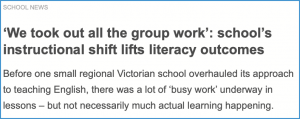
Even if we temporarily entertain the proposition that reducing group work improves literacy outcomes, the next question is surely: what are students potentially losing in exchange?
Schools are not literacy score production plants. They remain one of the last societal institutions where young people can learn how to collaborate, disagree respectfully, solve problems collectively and navigate the social complexity of other human beings.
And frankly, I’m pretty tired of these capabilities being dismissed as “soft skills” when, in actuality, they’re civilisation-level skills.
Dr Vivek Murthy’s book Together makes a compelling case that loneliness and disconnection are now among the most serious public health challenges facing western societies. If that’s true – and geez, it appears to be – then schools carry a responsibility extending well beyond producing academic performance. Young people need opportunities to think together, struggle together and develop relational confidence with one another.
And importantly, the research around cooperative learning is far more sophisticated than this headline suggests.
When I was a primary principal, we implemented Kagan Cooperative Learning as a strategic priority. We weren’t anti-literacy or uninterested in academic rigour. We did it because structured collaboration improved engagement, participation, belonging and provided students with safer pathways into deeper learning.
Done poorly, group work absolutely becomes busy work. Done well, it develops both academic understanding and the human capabilities increasingly demanded beyond school.
That’s also why I get nervous when educational tools stop being tools and start becoming ideology.
Chunking is useful. Explicit teaching is useful. Cooperative learning is useful. Feedback is useful. None of them are magic and none of them should be scaled into simplistic silver bullets at the expense of everything else.
A literacy gain is wonderful. So is producing young people capable of connection, collaboration and collective problem-solving in a society increasingly struggling to hold itself together.
Those goals are not enemies, and I’m increasingly concerned by how often modern education debates pit them against each other.
Keep fighting that good fight,
P.S. We had a heap of requests from teachers to run the Restorative Classroom Playbook online workshop during the school holidays, so we’ve added a special July session. If you’ve been wanting practical behaviour strategies, restorative responses and classroom tools you can put to work immediately, this is your chance to learn them before Term 3 begins.
The Restorative Classroom Playbook
Live, online and interactive
Friday 26 June 2026
Want to subscribe to Adam’s Home Truths? Simply subscribe here.